Choosing well · 4 min read
How to measure your child’s shoe size at home
A sheet of paper, a pencil and a wall are all you need. Three small secrets to an accurate measurement: in the afternoon, standing up, and both feet.
Ece Demirtaş, MSc PT
This content is for general information and is not a substitute for medical advice. If you have any concerns about your child’s feet, talk to your paediatrician or a paediatric physiotherapist.
In short
- Measure in the afternoon, with your child standing and wearing the socks they’ll wear with the shoes.
- Measure both feet and go by the longer one.
- Add about 1–1.5 cm of growing room to the foot length.
- Studies suggest that many children wear shoes that are too short for their feet, which is why regular measuring matters.
Why measure at home?
Young children can’t always tell you when their shoes pinch; they adapt by curling their toes. A community-based study in Austria found that a large share of children were wearing shoes shorter than their feet. So it’s the foot itself you need to look at, not the size printed on the shoe.
Getting ready
Before you start:
- Choose the second half of the day; feet lengthen a little over the course of the day.
- Put on the socks your child will wear with the shoes.
- Have your child stand, with their weight spread evenly over both feet.
Measuring with a ruler, step by step
The simplest method needs only a sheet of paper, a pencil and a ruler:
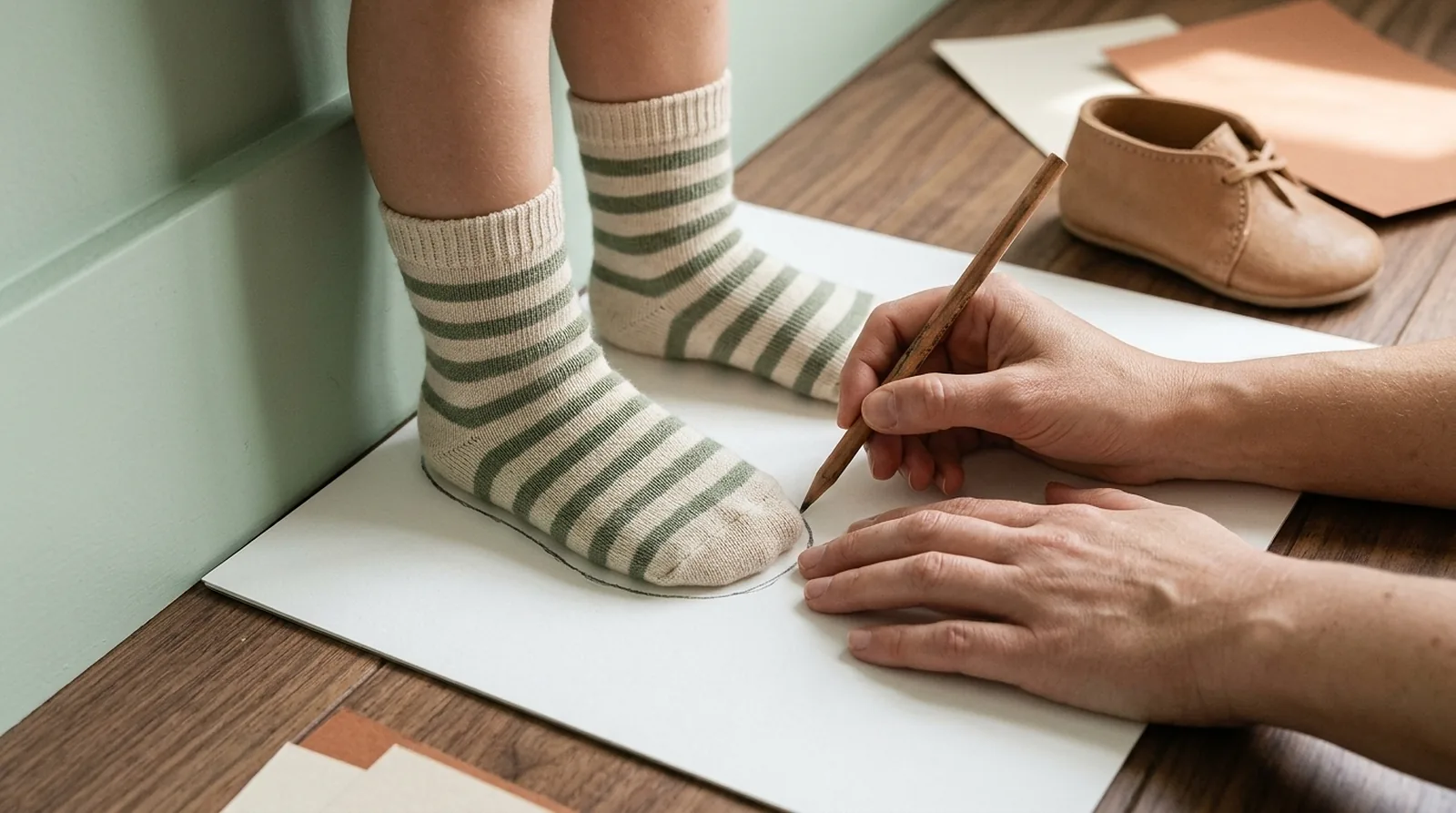
- Place the paper on the floor with its short edge against the wall.
- Have your child stand with their heel against the wall.
- Holding the pencil upright, mark the tip of the longest toe. It isn’t always the big toe.
- Measure the distance from the wall to the mark, to the nearest millimetre.
- Repeat for the other foot and note the longer one.
I’ve measured. What now?
The right size is the one whose inside length equals the length you measured plus about 1–1.5 cm of growing room. Our size chart already includes 1.2 cm for this, so all you need to do is enter the length you measured in the Size Finder.
When the shoes arrive, press on the toe while your child is standing: there should be about a little finger’s width of space between the longest toe and the end of the shoe. If the toes touch the end, the shoe is too small; if the heel slips, it’s too big.
When to ask a specialist
If you measure a difference of more than 1 cm between the two feet, or your child keeps wanting to take their shoes off, you may want to talk to a paediatric physiotherapist.
Free 20-minute call with a specialistSources
- Research Klein C, Groll-Knapp E, Kundi M, Kinz W. Increased hallux angle in children and its association with insufficient length of footwear: a community based cross-sectional study. BMC Musculoskeletal Disorders. 2009;10:159.
- Research Barisch-Fritz B, Schmeltzpfenning T, Plank C, Grau S. Foot deformation during walking: differences between static and dynamic 3D foot morphology in developing feet. Ergonomics. 2014;57(6):921–933.
- General guideline Common measuring advice from children’s shoe retailers and paediatric physiotherapists (general practice; not based on a single source).
Not a substitute for medical advice. If you have any concerns about your child’s feet, talk to your paediatrician or a paediatric physiotherapist.