Choosing well · 5 min read
How fast do feet grow? Keeping track of size changes
In the early years, feet can go up a size every few months. How often should you measure, and how can you tell when shoes are too small?

Ece Demirtaş, MSc PT
This content is for general information and is not a substitute for medical advice. If you have any concerns about your child’s feet, talk to your paediatrician or a paediatric physiotherapist.
In short
- Roughly: one size every two months from 0–12 months, every three months from 1–3 years, every four months from 3–6 years.
- Growth isn’t steady; it comes in spurts.
- Children can’t always tell you their shoes are too small; measuring is the most reliable way to know.
- The lid of the Misura box becomes a record of their growth.
Rough rates
Foot growth varies from child to child and isn’t steady: some months the foot seems not to grow at all, then it jumps half a size in a few weeks. Even so, there are widely accepted rough figures that help parents plan: in the first year a foot may go up a size roughly every two months, from 1–3 years every three months, and from 3–6 years every four months.
These are approximate figures based not on a single study but on clinical observation and shoemakers’ sizing data. Your own measurements are the best guide to your child’s pace.
How can you tell they’re too small?
- You see red marks on the toes or along the edge of the foot when you take the shoes off.
- Your child doesn’t want to put their shoes on, or keeps wanting to take them off.
- The toes touch the end of the shoe when you press on it while your child is standing.
- Their walking has changed, or they trip often.
Keep a growth record
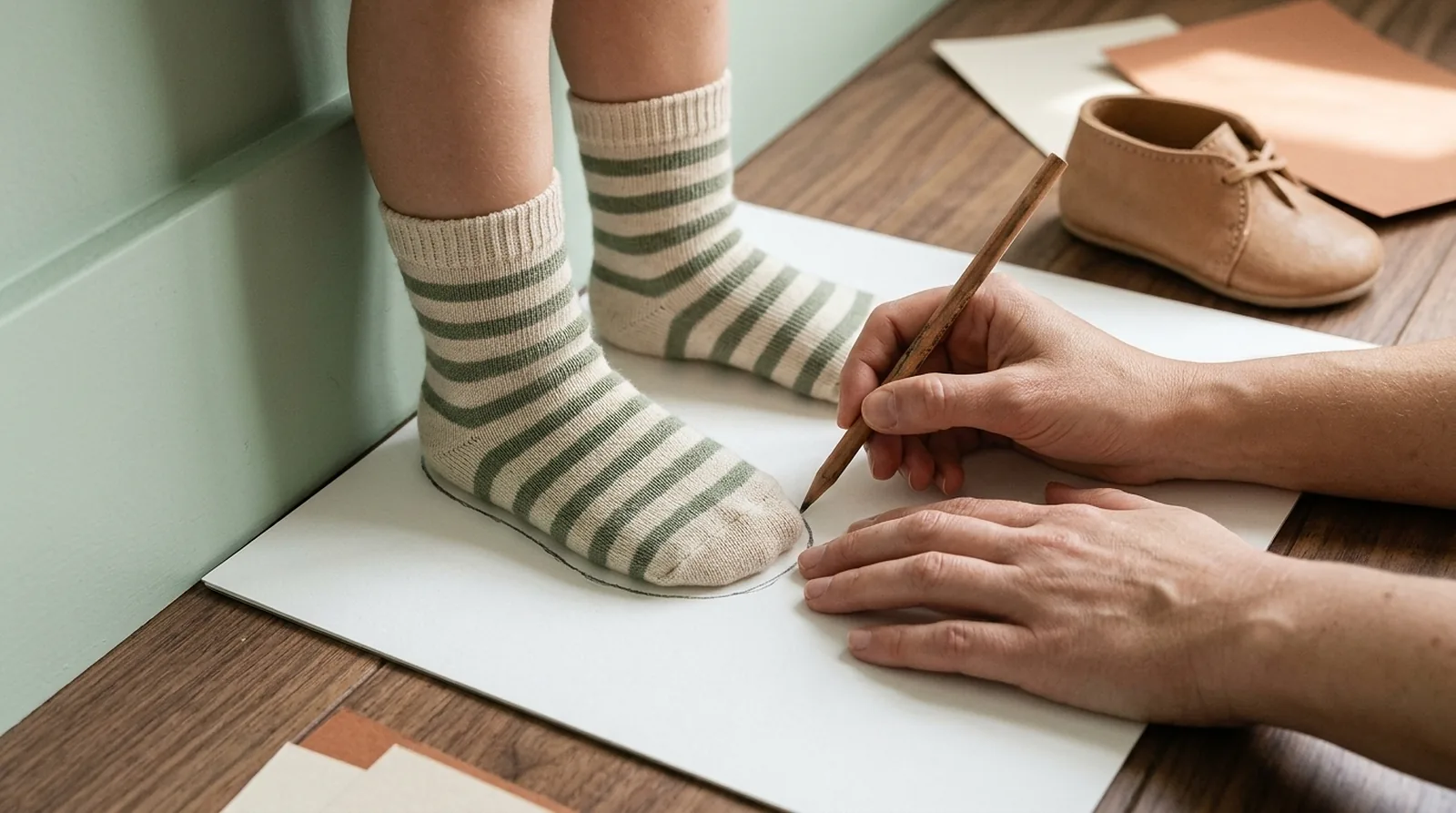
Noting each measurement with its date makes it easier to predict when you’ll need the next size. The inside of our Misura box lid was designed for exactly this: at each measurement you can draw around the foot and write the date. Years later, it becomes a keepsake you can look at together with your child.
If you save measurements to your Founding Family profile, we’ll remind you when the next measurement is due.
Is buying bigger the answer?
Buying a size or two bigger can be tempting, but in a shoe that’s too big the foot slides, the child curls their toes to hold the shoe on, and the risk of tripping goes up. That is why we don’t recommend more than 1–1.5 cm of growing room. You can send outgrown shoes back to us through the Take Back programme; they come back to you as points towards the next pair.
When to ask a specialist
If the difference between the two feet is growing, or one foot is growing noticeably faster than the other, talk to your paediatrician.
Free 20-minute call with a specialistSources
- General guideline Common clinical observations on the rate of foot length growth, and shoemakers’ size charts (approximate figures; these vary from child to child).
- Research Klein C, Groll-Knapp E, Kundi M, Kinz W. Increased hallux angle in children and its association with insufficient length of footwear: a community based cross-sectional study. BMC Musculoskeletal Disorders. 2009;10:159.
Not a substitute for medical advice. If you have any concerns about your child’s feet, talk to your paediatrician or a paediatric physiotherapist.